Dogs Are Good for Kids

Owen Murphy
| 04-06-2026
 · Animal Team
Ask a kid who they'd go to with a serious problem and a surprising number of them — across multiple studies — name their dog. Not a parent, not a best friend.
The dog. That says something pretty profound about what these animals actually mean to children, and it's backed up by a growing pile of research into how dog ownership shapes child development. The short version: the benefits are real, measurable, and span emotional, cognitive, and physical health.
Self-Esteem Grows With Responsibility
When children are given age-appropriate tasks related to caring for a pet, their self-esteem measurably improves. A three-year-old filling a water bowl is doing something genuinely useful. A seven-year-old helping prepare a dog's meal twice a day is learning that their actions matter and that another living creature depends on them. That kind of concrete, daily responsibility — with immediate visible results — builds a sense of competence that carries into other areas of life.
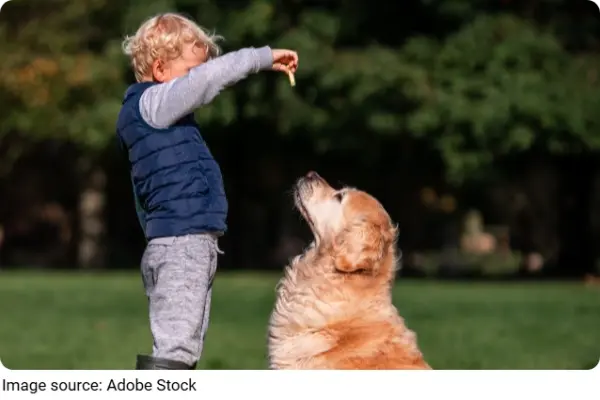
Empathy and Compassion — the Research Is Clear
Multiple studies consistently show that children who grow up with pets are more empathetic toward others than children who don't. The proposed mechanism is straightforward: when families share the work of caring for an animal, children observe and participate in nurturing a dependent creature from a young age. That experience develops the capacity to understand and respond to the needs of others — both animal and human.
"Pets can make people feel unconditionally accepted, whereas fellow humans will judge and may criticize," researchers Endenburg and Baarda note in their work on pets and child development. That experience of unconditional acceptance becomes foundational.
Stress Relief That Actually Works
Petting a dog lowers cortisol in both the person doing the petting and the dog itself. For children specifically, research from the University of Florida found that kids between 7 and 12 performing stressful tasks — public speaking, math questions — had significantly lower cortisol levels when their dogs were present, compared to children with parents present or no support at all. Lower than when parents were there. The dog outperformed human emotional support in that particular stress scenario.
Children also show reduced anxiety when reading aloud to a dog. Some schools and animal rescue organizations have formalized this into programs precisely because of the consistent results.
Cognitive Development Gets a Boost
Kids who talk to pets — giving commands, offering praise, or simply babbling — show improved cognitive development compared to children who don't. The conversation itself, even one-sided, seems to build language skills and processing capacity. The physical activity that comes with dog ownership adds another layer: more outdoor time, more movement, better overall development.
Physical Health — the Allergy Connection
Several studies suggest that children who grow up in homes with dogs have a lower likelihood of developing allergies. One Swedish study published in JAMA Pediatrics found that children who lived with dogs during their first year had a 15% lower risk of developing asthma by age six compared to children without dogs. The same early exposure effect that seems counterintuitive — shouldn't allergens cause allergies? — appears to help calibrate the immune system during a critical developmental window. Playing with a dog also raises serotonin and dopamine levels in children, which calms the mind and lifts mood. Genuinely. Not metaphorically. These are measurable neurochemical changes that happen during play.

Growing up with a dog isn't just a fond memory to look back on. The developmental research suggests it leaves a real mark — on emotional intelligence, resilience under stress, and physical wellbeing — that lasts well beyond childhood.